7 Essential Steps to Understand and Create Flash USDT on ChainIDE
· based on the channel Rca FastPrint
Flash USDT is a method to create and interact with USDT-like tokens using smart contracts on the Ethereum blockchain. It leverages the ChainIDE development environment and MetaMask wallet integration to offer a streamlined workflow from contract coding to wallet interaction. Understanding Flash USDT involves knowing how smart contracts work, how ERC20 tokens are structured, and how to safely deploy and test these tokens.
1 Understand the Flash USDT Concept and ERC20 Token Structure
Flash USDT is essentially a custom ERC20 token that mimics USDT functionality but is created through a specific method on ChainIDE. ERC20 tokens follow a standard interface that includes functions such as `transfer`, `approve`, and `balanceOf`. The Flash USDT method uses this standard to build a token that can be managed and transferred on the Ethereum network. The concept is aimed at developers looking to create test or development tokens rather than real USDT.
2 Set Up Your Environment on ChainIDE
ChainIDE (https://chainide.com/) is an online integrated development environment for blockchain developers. To start creating Flash USDT, you need to register and familiarize yourself with ChainIDE's interface, which supports Solidity smart contract development. This environment allows you to write, compile, deploy, and test smart contracts all in one place without local setup complexities.
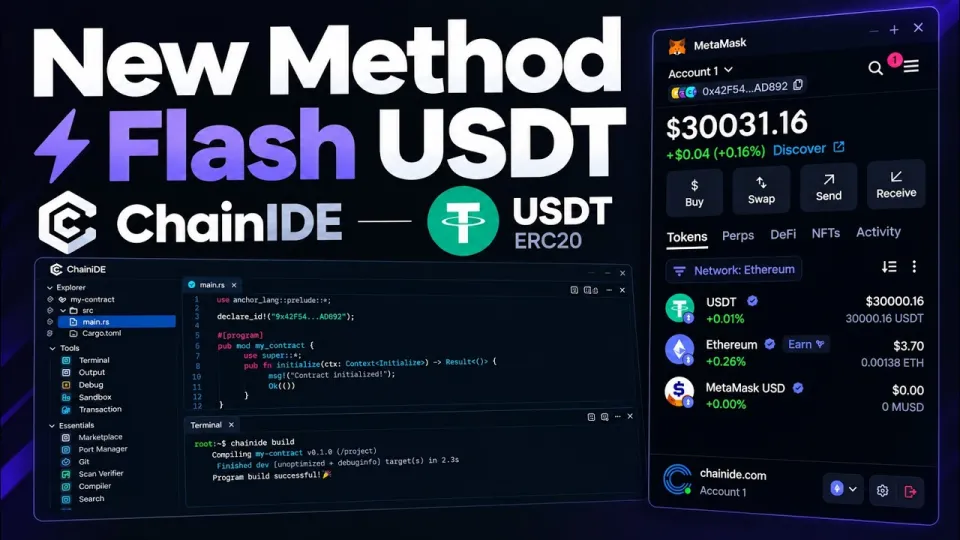
Video: Flash USDT | Found a NEW Method on ChainIDE
3 Write and Deploy the Flash USDT Smart Contract
Using Solidity, you write a smart contract that defines the Flash USDT token's parameters—such as name, symbol, decimals, and total supply. The ChainIDE platform provides scripts and templates, available at https://sites.google.com/view/defiflashusdt, to facilitate this process. After coding, compile the contract and deploy it to a testnet or Ethereum mainnet using ChainIDE's deployment tools integrated with MetaMask.
4 Connect and Interact with MetaMask Wallet
MetaMask is a browser extension wallet that interacts with Ethereum and compatible blockchains. After deploying your Flash USDT contract, connect your MetaMask wallet to the same network. This setup allows you to send transactions, approve token transfers, and verify balances directly through the wallet interface. Always verify contract addresses and transaction details before confirming any action.
5 Test and Verify the Flash USDT Setup
Testing is critical to ensure the Flash USDT contract behaves as expected. Use ChainIDE’s console and blockchain explorers to check token transfers, allowance approvals, and other ERC20 functions. Verification also involves checking the source code and contract address on the blockchain to confirm authenticity and to avoid interacting with malicious contracts.
6 Common Mistakes and Security Precautions
When creating or using Flash USDT, avoid sending real funds to unverified contracts. Common mistakes include incorrect contract addresses, network mismatches, and overlooking gas fees. Always review the source code, perform tests on testnets first, and never share private keys. Flash USDT is primarily for educational and development use, not for actual value transfers without proper audits.
7 How to Use Flash USDT Safely and Effectively
To maximize the benefits of Flash USDT, use it within controlled environments for learning, testing DeFi applications, or developing new token functionalities. Combine ChainIDE’s tools with MetaMask’s secure wallet features, and keep updated with community resources like Telegram channels such as @erdincrca for support. This method provides a practical way to explore ERC20 token creation without risking real assets.
Useful Links
- ChainIDE official site for development and registration: https://chainide.com/
- ChainIDE Flash USDT script and guide: https://sites.google.com/view/defiflashusdt
Summary
Flash USDT offers a new method for creating and interacting with ERC20 USDT-like tokens using ChainIDE and MetaMask. By following 7 essential steps—from understanding the token structure to deploying and testing—you can safely explore smart contract development and token management. Always prioritize security by verifying contracts and conducting thorough testing. This article and the detailed video analysis by the Rca FastPrint channel provide valuable insights for anyone interested in blockchain development and DeFi experimentation. Visit ChainIDE to start your Flash USDT development journey.
Key takeaways
- Flash USDT is an ERC20 token method developed using ChainIDE.
- MetaMask wallet is used for interacting with the Flash USDT smart contract.
- ChainIDE provides a development environment for smart contract coding and testing.
- The Flash USDT method involves creating, deploying, and verifying a token contract.
- Security checks and verification are crucial before interacting with any contract.
Source: Flash USDT | Found a NEW Method on ChainIDE · Markdown version
Questions & answers
What is Flash USDT and how does it differ from regular USDT?
Flash USDT is a custom ERC20 token created using a development method on ChainIDE. Unlike regular USDT issued by Tether, Flash USDT is typically used for educational, testing, or development purposes rather than as a real stablecoin.
Is it safe to send real funds to Flash USDT contracts?
No, it is not recommended to send real funds to unverified or unknown Flash USDT contracts. These contracts are often for testing or demonstration purposes and may not have undergone security audits.
How does ChainIDE facilitate the creation of Flash USDT?
ChainIDE provides an integrated online environment where you can write, compile, deploy, and test smart contracts like Flash USDT tokens without installing local tools. It supports Solidity coding and integrates with wallets like MetaMask.
Can I use MetaMask with Flash USDT tokens?
Yes, MetaMask can be connected to the Ethereum network where the Flash USDT contract is deployed. It allows you to interact with the token by sending transactions, approving transfers, and checking balances securely.